
I believe that my research project answers the question and follows the structure that was set out for us. Each new page has a heading which lists one of the criteria we were set to do - these titles are quite large making the project look slightly unprofessional, but other than this I think it's a good way of setting out my essay.
I feel that the throughout this project I explore the question and show a clear understanding from my research. Furthermore I conclude with a good answer to the question which references all of my points made in my research. As far as presentation goes with my project I think that mine was very stylised and bold which made it stand out, however because of this it doesn't look very formal and some of the text is far too large (paragraphs could be written in a much smaller font.) Also I used a range of my own film photos which was a nice touch but I could have included some diagrams or graphs. Nevertheless I hope that the presentation made it enjoyable to read. As far as I know the spelling, punctuation and grammar is spot on in this project with no mistakes.
Looking at the project overall I think that it was nicely laid out and easy to read - making it enjoyable to look at. It also explored the topic effectively and showed a range of different research methods. On the other hand, I could have performed some more research (both primary and secondary) such as another book, analysis of a documentary/film or a survey/focus group. Furthermore I could have tried to make the presentation look more professional and formal dependant on the audience.
Monday, 5 February 2018

Tuesday, 23 January 2018
Presentation Feedback
Positives
-Lots of reliable research (primary & secondary)
-Range of research methods
-Strong conclusion
-Good interview
-Justification of conclusion
-Clearly spoken
-Good use of statistics
Negatives
-Use image/video in presentation
-Text heavy slides
-Read out quotes
-Reading off board
-Explain what analog photography is for those who may not know
-Lots of reliable research (primary & secondary)
-Range of research methods
-Strong conclusion
-Good interview
-Justification of conclusion
-Clearly spoken
-Good use of statistics
Negatives
-Use image/video in presentation
-Text heavy slides
-Read out quotes
-Reading off board
-Explain what analog photography is for those who may not know
Friday, 12 January 2018
Case Study Blog
Interview Led Documentary
Similar style Interview Led Documentary
When shooting interview led video, I found it easier to plan in terms of pre-production and production. I thought this because you're able to capture the goings on with no main intention and shooting what's best in the moment. During the edit of productions like this the video can be driven by the interview and footage can be overlayed that relates to what's being spoken about.
When watching interview led production I felt that they have a personal and intimate feel, as it feels like the individual related to the video is talking you through it and narrating it in some cases. In the YouTube documentary above used as an example, the intimacy is conveyed by the close ups of the individual, in a similar way to having a conversation with the person. For this reason the viewer may feel more connected with this style of documentary compared to presenter led styles - there's no barrier between the viewer and the subject. The editing of these is usually quite fast paced as they cut intermittently between interview and b-roll, so this is effective in keeping the viewers attention and the tempo of the story high.
Presenter Led Documentary
Similar Style Presenter Led Documentary
Presenter led video is more challenging to shoot than interview led in my opinion. When shooting the documentary on amphibians above, we had to work with the presenter to give them lines and make sure they led the story continually throughout the shoot. It also meant that when filming different scenes we had to consider the presenter and their location in the shot with things such as continuity - which also affected the edit and order of shots.
After watching my presenter led production and comparing it to a similar short from Vice on YouTube, I found that this style of documentary felt more formal and report-like. In my opinion I find this is a more forced feel and not as appealing as something interview led. It doesn't feel like as much of a story as interview led productions and isn't as immersive. Viewers may still feel drawn in by this style of video as the editing is fast paced, although there are sections of explanation from the presenter at points which can change up the pace, slowing it down.
My production approach
I've decided that for my production I'm going to work with Max to create an interview led documentary on the topic of fashion design and streetwear. I chose this style of production because I feel like it's more appropriate for the topic to have someone 'in the know' talking throughout the video rather than a presenter who wont be as informed on the subject. I also find this style more fun to edit and interesting to watch as it gives the viewer a deeper insight into the individuals on screen, similar to having a conversation with them. I chose this topic since clothing and fashion is something close to my heart which is a big part of my everyday life. Furthermore my friend Aiden is a young, up-and-coming fashion designer who designs and manufactures garments independently which is a unique subject to present - and will hopefully draw in an audience. I also plan to include an interview with someone who is a consumer of fashion (more importantly streetwear) to give some contrast to the video and give viewers an idea of what the 'scene' is like.
I want to make sure that this production is of a high standard and watches well, captivating the viewer. To do this I will need to make sure I think quickly during production to capture the best possible shots as they happen, as you can't go for another take when shooting documentaries (as learnt in previous projects!). I will also need to think skilfully during pre-production to plan out effective questions to ask for the interviews and techniques to follow in order to get the best answers. Lastly I'll need to push my editing abilities to cut everything together into a professional looking and smooth running product. During this production I'm likely to face some issues and have to find my way around them, but I know that this and all of the other points I mentioned are going to push me and help me to develop as a producer.
Similar style Interview Led Documentary
When shooting interview led video, I found it easier to plan in terms of pre-production and production. I thought this because you're able to capture the goings on with no main intention and shooting what's best in the moment. During the edit of productions like this the video can be driven by the interview and footage can be overlayed that relates to what's being spoken about.
When watching interview led production I felt that they have a personal and intimate feel, as it feels like the individual related to the video is talking you through it and narrating it in some cases. In the YouTube documentary above used as an example, the intimacy is conveyed by the close ups of the individual, in a similar way to having a conversation with the person. For this reason the viewer may feel more connected with this style of documentary compared to presenter led styles - there's no barrier between the viewer and the subject. The editing of these is usually quite fast paced as they cut intermittently between interview and b-roll, so this is effective in keeping the viewers attention and the tempo of the story high.
Presenter Led Documentary
Similar Style Presenter Led Documentary
Presenter led video is more challenging to shoot than interview led in my opinion. When shooting the documentary on amphibians above, we had to work with the presenter to give them lines and make sure they led the story continually throughout the shoot. It also meant that when filming different scenes we had to consider the presenter and their location in the shot with things such as continuity - which also affected the edit and order of shots.
After watching my presenter led production and comparing it to a similar short from Vice on YouTube, I found that this style of documentary felt more formal and report-like. In my opinion I find this is a more forced feel and not as appealing as something interview led. It doesn't feel like as much of a story as interview led productions and isn't as immersive. Viewers may still feel drawn in by this style of video as the editing is fast paced, although there are sections of explanation from the presenter at points which can change up the pace, slowing it down.
My production approach
I've decided that for my production I'm going to work with Max to create an interview led documentary on the topic of fashion design and streetwear. I chose this style of production because I feel like it's more appropriate for the topic to have someone 'in the know' talking throughout the video rather than a presenter who wont be as informed on the subject. I also find this style more fun to edit and interesting to watch as it gives the viewer a deeper insight into the individuals on screen, similar to having a conversation with them. I chose this topic since clothing and fashion is something close to my heart which is a big part of my everyday life. Furthermore my friend Aiden is a young, up-and-coming fashion designer who designs and manufactures garments independently which is a unique subject to present - and will hopefully draw in an audience. I also plan to include an interview with someone who is a consumer of fashion (more importantly streetwear) to give some contrast to the video and give viewers an idea of what the 'scene' is like.
I want to make sure that this production is of a high standard and watches well, captivating the viewer. To do this I will need to make sure I think quickly during production to capture the best possible shots as they happen, as you can't go for another take when shooting documentaries (as learnt in previous projects!). I will also need to think skilfully during pre-production to plan out effective questions to ask for the interviews and techniques to follow in order to get the best answers. Lastly I'll need to push my editing abilities to cut everything together into a professional looking and smooth running product. During this production I'm likely to face some issues and have to find my way around them, but I know that this and all of the other points I mentioned are going to push me and help me to develop as a producer.
Wednesday, 10 January 2018
Test Shoots Reflection
For this project we performed some test shoots (both photo and video) in potential set locations. This was to get an understanding of the light in these areas and the space we had to work with.


Test shooting in the plane cabin made us aware that it's quite tight for space, meaning we need to be decisive with what kit we use in there and how we shoot it. We have lots of creative control lighting the scene as external light can be blocked out although we need to make sure we're effective with how many lights we bring in and use. A plus-side of the small space is that through the lens it's easy to make the cabin look busy and therefore more realistic. This also means we don't have to try and fill up the whole area with actors and on the day of the shoot it should be simple to organise them. On the flipside it can also be made to look larger than the area actually is - with these two effects we can play around with them to give a dream-like atmosphere.


With the cabin mock-up some creative and unusual shots can be achieved which have the possibility to confuse and disorientate the audience, which is perfect for our dream sequence. The perspective inside is quite unusual and theres lots of straight lines and shapes which give it a geometric feel.


Click this link to see a short cut of some shots we got in the cabin.
Another area we investigated was the salon in Bath College. We figured the reception here could be repurposed into a dentists reception for the short film. As shown by the photos it's a very large space and looks dull and bleak due to the empty walls. We wanted the location to be boring and mirror the character so this is perfect for the reception location. The empty walls also mean we can add relevant posters if needed.

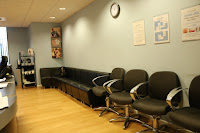
The location looks industry standard for a reception and having this level of realism will be effective in making the short film look professional. One issue that we face however is the branding on the wall. This could either be removed in post production (which isn't ideal as ideally we'd like as little work as possible during post) or we could try to get shots which avoid showing this. Lastly, the wide space is successful in making the character look alone and isolated (as shown in the photo on the right). This helps to convey underlying feelings the character may be experiencing and atmospheres to the audience.


Test shooting in the plane cabin made us aware that it's quite tight for space, meaning we need to be decisive with what kit we use in there and how we shoot it. We have lots of creative control lighting the scene as external light can be blocked out although we need to make sure we're effective with how many lights we bring in and use. A plus-side of the small space is that through the lens it's easy to make the cabin look busy and therefore more realistic. This also means we don't have to try and fill up the whole area with actors and on the day of the shoot it should be simple to organise them. On the flipside it can also be made to look larger than the area actually is - with these two effects we can play around with them to give a dream-like atmosphere.


Click this link to see a short cut of some shots we got in the cabin.
Another area we investigated was the salon in Bath College. We figured the reception here could be repurposed into a dentists reception for the short film. As shown by the photos it's a very large space and looks dull and bleak due to the empty walls. We wanted the location to be boring and mirror the character so this is perfect for the reception location. The empty walls also mean we can add relevant posters if needed.


The location looks industry standard for a reception and having this level of realism will be effective in making the short film look professional. One issue that we face however is the branding on the wall. This could either be removed in post production (which isn't ideal as ideally we'd like as little work as possible during post) or we could try to get shots which avoid showing this. Lastly, the wide space is successful in making the character look alone and isolated (as shown in the photo on the right). This helps to convey underlying feelings the character may be experiencing and atmospheres to the audience.


Tuesday, 9 January 2018
Concept Art Reflection


In my sketchbook I have created a rough sketch of the main characters of the film, to get a feel for how they'll look and more importantly explore their costumes. For our protagonist we chose to show that he's an average young adult, who's not rich but not poor. Because of this he's wearing jeans and a grey t shirt. We chose the colour grey as sweat is easily visible on this colour of fabric, and at times in the production we would like to show that he's feeling anxious and nervous, so this is one straight forward way to do so.

Storyboard Reflection


As shown in the storyboards, the short film will mainly be focused on the main character - Luke, and the majority of shots will be fixed on him. The first few opening shots are wide to show the vast space Luke is waiting in and will connote the dull atmosphere to the audience. The intermittent close ups of the clock will convey Luke's distractions and nervousness, while at the same time showing time passing and giving intensity to this. When he enters the dreamscape the shots become closer to Luke to give the feeling of intimacy and connection to the character. Some unusual shot types will be used here too such as different angles and camera movements, to further display the dream 'world' and give a slight sense of unnaturalness. The final shots will replicate the first shots to show we're back in the real world and the same setting we started off in.
Hopefully by linking settings through shot types and conveying atmospheres through angles and camera movements, the film will be effective in engaging an audience and helping them to relate to the film.
Script Reflection
Dreamscape Project Script

The script for our group's short film is fairly concise as most of the film will rely on visuals. The short is made up of an eerie dream montage/sequence set in an airplane cabin, with scenes in a dentist reception before and after to give context. We made the decision to put emphasis on the dream sequence because this is what the project's main focus is. The points where we have chosen to use dialogue help to link the character (and audience) between the real world and the dream world through the airplane tannoy and the dentist receptionist whose voices are the same. We also link the real world to the dreamscape by using the same character for the dentist receptionist and the air hostess. Leading up to the shoot I hope to annotate this script and refine some aspects of it as I feel theres still improvements to be made.
Friday, 1 December 2017
Relationship Between Characters
 |
| Original Shoot (Watch Here) |
When planning out a story to shoot, the pre-production is one of the most important stages. A significant part of the pre-production is the characters and script - dialogue drives and develops the plot the most. At this point of planning, the idea of the characters in your head and their relationships are fairly vague. Writing dialogue is a struggle and can take lots of revisions and changes. One thing to consider when writing is how the actor will deliver the line - Will they be feeling a certain emotion? What speed will they say it? What expression will they have? - this needs to be listed in the script as a parenthetical remark. All of these things become a bit clearer when shooting.
 |
| Drama Student Shoot (Watch Here) |
At this stage of production you work with the actors and can see the characters develop their personalities and relationships, as there is a real person to represent them. During conversations you can present the characters through their reactions, emotions and delivery of dialogue which can be done by directing the actors. As there are many takes, you can observe how the actors act and in-between takes speak to them about what you want them to change or do.
Finally, in the edit you have the ability to pick and choose how much of a certain emotion or reaction to show, and what order the shots are in. During editing you need to not only consider showing the characters when they react and speak, but also think about the flow of the scene and make sure it doesn't seem mechanical. If done well this can achieve different atmospheres/emotions or build tension etc. making a gripping and intriguing film for the viewer. Getting the intimacy right between the audience and characters can be essential. This can go on to invoke an emotional connection from the viewers.
Tuesday, 21 November 2017
What is a Research Project?
To put it simply; a research project is a large piece of formal, detailed writing, with images and external sources that explores an idea or subject. It is usually done to increase ones knowledge on something and give them the ability to learn more. As put forward by Successful Writing "A research paper presents an original thesis, or purpose statement, about a topic and develops that thesis with information gathered from a variety of sources."
Potential content in a research project is similar to a book, in that there's a front cover followed by a bulk of writing. Content may include primary and secondary research, statistics to back up points, images on occasion and lastly extracts from past publications, data from documentaries and films. Throughout the research project the writing should be of a formal, detailed standard and use Harvard referencing. This means that references must be listed in a research journal/bibliography in a Harvard Referencing format (Author, Year of Publication, Title, Place of Publication, Publisher) for books.
Potential content in a research project is similar to a book, in that there's a front cover followed by a bulk of writing. Content may include primary and secondary research, statistics to back up points, images on occasion and lastly extracts from past publications, data from documentaries and films. Throughout the research project the writing should be of a formal, detailed standard and use Harvard referencing. This means that references must be listed in a research journal/bibliography in a Harvard Referencing format (Author, Year of Publication, Title, Place of Publication, Publisher) for books.
Exploring and Evaluating Ideas


After completing these three mind maps, I decided that I wanted to base my research project on 35mm film photography. I had created two mind maps with a similar topic: ("Why is film used today and is it still a valid medium" & "Why has film photography become more popular in recent years"). Out of these I have decided to focus on why film has become more popular recently. This is because I can relate it the the modern day photography industry and look into statistics. Furthermore looking into film photography will be an exciting project for me as it is a medium I find aesthetically pleasing and interesting as it's so aged.
Why use Harvard Referencing?
Using Harvard referencing in a research project (if not in all work) is essential to ensuring your work is professional and of high quality. For example, using Harvard referencing helps to avoids plagiarism by letting the reader know where certain data is sourced from and who created it (the author). In order to properly reference a piece of writing for example, it needs to be included with an in text citation and a full reference in your bibliography (or reference list). This form of referencing is also helpful as you can include data using it to back up research you're conducting to make a more impactful point. Furthermore it lets the reader know that you've committed to your research and explored different books, websites, magazines etc.
When referencing a book for example, the reference would look like this:
When referencing a book for example, the reference would look like this:
Bell, J. (2010) Doing Your Research Project.
5th ed. Maidenhead: Open University Press.
The authors surname followed by their initials: "Bell, J.", the year of publication in brackets "(2010)", the title in italics with the edition if it applies "Doing Your Research Project. 5th ed" and lastly the place of publication and publisher "Maidenhead: Open University Press.". This covers all relevant information to not only show exactly where you've sourced the data, but also to let the reader find the data for themselves.
Thursday, 2 November 2017
Interview Reflection
Interviewing someone from the industry gave me a great perspective of media and the real life practical aspects of it. From completing this task I learnt 3 main things. Firstly, I discovered that I should keep doing things related to media, be it watching films, taking photos, writing scripts or experimenting. The second thing I learnt was that any work in the industry is good work, even if unpaid. It enables you to make contacts and connections which is vital and can help towards you getting noticed. Lastly I found that I should try to make a portfolio and show myself off. This means that when people ask or find out about you, you have something to say for yourself.
Wednesday, 18 October 2017
Critical Analysis - Contextual Studies
Portfolio
Strengths-Had a minimalistic layout - didn't look too complicated
- Was organised into sections and neat looking
-Shows a variety of photography types, letting viewers know my range of skills
Areas for Improvement
-Content limit - more photos could have been added
-Not much information, add text for details
-No contact information or details about me
3 Things I've learnt by completing these tasks
-Important to get yourself out there online
-It can prove quite challenging to make your own website
-Constantly keep creating content
Presentation
Strengths-It was to the point and concise
-Arranged in an easy to understand manner
-Good choice of goals
Areas for Improvement
-Too simplistic - add photos maybe?
-Short length, add more information/goals? Go into more depth
-Present it better - use gestures, face the audience etc
3 Things I've learnt by completing these tasks
-Work hard to get into uni - the sooner the better
-Do independent research/work outside of college
-Contribute/go the extra mile in lessons
Tuesday, 17 October 2017
12 Month Personal Development Action Plan
For my 12 month development action plan I've split the plan into three main goals and gone into detail of each goal, listing details of the goal and how I can achieve it in a specific timeframe. My first goal and most important goal to me is to get into University to do a course in either film or photography.
To do this I'll need to work on a personal statement and have this complete, ready to send off before the 15th January (which is the deadline for applications). I'd like to have my personal statement complete on the 15th November so that I can apply to Universities sooner rather than later. This seems like quite a daunting task so to get this done I'll need to set out a plan for each paragraph of the personal statement, brainstorm ideas of what to say & do research online by watching videos and reading articles and other personal statements. I'll also need to ask for feedback from my lecturers and adults so I can keep adapting and improving the personal statement.
To do this I'll need to work on a personal statement and have this complete, ready to send off before the 15th January (which is the deadline for applications). I'd like to have my personal statement complete on the 15th November so that I can apply to Universities sooner rather than later. This seems like quite a daunting task so to get this done I'll need to set out a plan for each paragraph of the personal statement, brainstorm ideas of what to say & do research online by watching videos and reading articles and other personal statements. I'll also need to ask for feedback from my lecturers and adults so I can keep adapting and improving the personal statement.
Next I'll need to find some University courses that apply to me so I can apply to them and have good options (if I get a place). I have some universities in mind already but I'd like to find a couple more and ideally I'd like to have this done by the end of the month, so to make a sound decision of courses I need to read their prospectuses and look at their websites which will state what they look for in a student.
Lastly I'll need to take action on what the university websites say about ideal students and make myself appealing to the university by acting on this. This will mean working to my best ability in this college course to try and get a distinction, and working on personal projects outside of college. I'd like to make at least one product a month up until University so I gain lots of experience and knowledge whilst also having some work to show for myself. This product could be something moving image based, audio based, or photography and design based. I'd also like to try and watch at least 3 films a week to get more familiar with analysing and understanding them, and again to gain experience.
My second goal is to improve in my college course so I can achieve the best grade possible, which will help to lead me on into higher education. I've split this section up into the three lessons we're taking this year: Contextual Studies, Moving Image and Audio. To begin with, for Contextual Studies I'd like to learn how to pitch better, which means delivering my ideas and presenting more effectively. This is because pitching is an important skill to have in the media industry and can help massively towards getting your ideas heard. To do this I'll need to research effective techniques online and practice pitching in these lessons.
Something I'd like to improve on in Moving Image lessons is knowledge on real life aspects of film and tv such as budgeting a production, lighting techniques, scriptwriting and storyboarding. I know how to do all of these things but I'd like to research them in more detail and learn how to do them better so I can improve my work. I'll be able to research all of these things online so I aim to be more skilled in all of these things by the end of the year.
For audio I want to become more familiar with sound in premiere so that I can apply this knowledge to my video productions. To do this I need to pay full attention and contribute in my audio lessons with Tom, as well as doing research and experimentation outside of college by watching videos on it and googling it.
My last main goal is for personal things outside of college. For these I'd like to make myself more attractive to future clients and employers which means making a portfolio and personal website. Which I aim to have completed by the start of 2018. I also need to work on independent projects outside of college with other creative individuals which I will do on my free days and in the holidays. Lastly I need to keep myself organised so I can work to my best ability. I can do this by setting deadlines and achievable tasks for myself.
I hope to check back on this blog monthly so I can see what I'm doing and what needs to be done, leading to my personal development.
I hope to check back on this blog monthly so I can see what I'm doing and what needs to be done, leading to my personal development.
Friday, 6 October 2017
Differential Focusing Techniques - Experimentation
In this lesson we experimented with different lenses and apertures to see how they affected the depth of field. As the aperture increases numerically the depth of field gets deeper. This video shows the different apertures + lenses I tested:
I concluded from this that a small aperture like f1.8 makes the background very blurred and soft, bringing focus to the foreground. (Professional look also) This looks better for portraits in my opinion. With a large aperture like f22 the background and foreground are both in focus so this should be better for location photography or trying to get a shot where everything is focuses on. Additionally, with the zoom lens fully zoomed in you need to bring the camera quite far back to get the subject in frame, which can be an issue. Another thing I noticed was that the perspective changes with lenses.
I concluded from this that a small aperture like f1.8 makes the background very blurred and soft, bringing focus to the foreground. (Professional look also) This looks better for portraits in my opinion. With a large aperture like f22 the background and foreground are both in focus so this should be better for location photography or trying to get a shot where everything is focuses on. Additionally, with the zoom lens fully zoomed in you need to bring the camera quite far back to get the subject in frame, which can be an issue. Another thing I noticed was that the perspective changes with lenses.
Enter the Pitch - Research
For the research of Enter the Pitch we needed to come up with a film idea which is based off the Bible. I'm not a Christian so I didn't have a lot of knowledge on Bible stories, however I have seen a few Biblical themed films such as 'Jesus Christ Superstar' and 'Joseph and the Technicolour Dreamcoat' so I had some knowledge.
To begin with, I brainstormed about what kind of film I wanted to make and thought of some of my favourite films, which let me to 'Goodfellas'. From this I decided I wanted to make a Gangster film. This is because in Gangster films I find the stories are gripping and I like the style and tension in these films. I looked at some clips from gangster films for inspiration and found a clip from 'Goodfellas II' where somebody is given the Kiss of Death:
I then remembered the part in the Bible where Judas betrays Jesus with a kiss as this is shown in the film 'Jesus Christ Superstar' and thought that these 2 things can be linked. This is because the kiss of death is a kiss of betrayal in the mafia, similar to how Judas' kiss betrays Jesus. For further research I looked at wikipedia pages of both of these subjects:
https://en.wikipedia.org/wiki/Kiss_of_Judas
https://en.wikipedia.org/wiki/Kiss_of_death_(mafia)
After this research I was able to come up with some good ideas for me to start planning out my film. To help me with this I made a moodboard to get some ideas and themes down such as similar films, styles, and time periods.

To begin with, I brainstormed about what kind of film I wanted to make and thought of some of my favourite films, which let me to 'Goodfellas'. From this I decided I wanted to make a Gangster film. This is because in Gangster films I find the stories are gripping and I like the style and tension in these films. I looked at some clips from gangster films for inspiration and found a clip from 'Goodfellas II' where somebody is given the Kiss of Death:
I then remembered the part in the Bible where Judas betrays Jesus with a kiss as this is shown in the film 'Jesus Christ Superstar' and thought that these 2 things can be linked. This is because the kiss of death is a kiss of betrayal in the mafia, similar to how Judas' kiss betrays Jesus. For further research I looked at wikipedia pages of both of these subjects:
https://en.wikipedia.org/wiki/Kiss_of_Judas
https://en.wikipedia.org/wiki/Kiss_of_death_(mafia)
After this research I was able to come up with some good ideas for me to start planning out my film. To help me with this I made a moodboard to get some ideas and themes down such as similar films, styles, and time periods.

Enter the Pitch - Pitch Reflection
For this module we had to work on our own film ideas for the competition "Enter the Pitch". To do this we had to come up with a film idea based off a Bible story and create a treatment and pitch for it. Once we had completed a treatment we had to pitch our film ideas. Below is my pitch which I will reflect on in order to improve my pitching skills for next time.
Overall I think I pitched my idea fairly effectively as I got the idea across in time and went through everything I wanted to. When watching my pitch back on video one main thing that stood out to me was my use of "uh's and like". This makes my pitch seem more unprofessional and not as concise which I'd like to try and improve on next time to clean up my pitch technique. Another thing I noticed I could improve on is my speed as I speak quite quickly. This can partly be justified as we had a 2 minute time limit but I think this is also something I can try to work on.
I also thought that to improve my pitching technique I could try and maintain better eye contact when pitching as this shows I'm more confident and that I have memorised my ideas (because I'm not looking at the notes as much). Furthermore, I thought that the use of hand gestures would make my pitching more effective. By using gestures I can get the idea across better and won't look as static.
In Conclusion, I think that I need to try and act more confidently when pitching and try to be more logical in my thinking and slow down when speaking. This will make my pitching a lot more professional looking and effective.
Overall I think I pitched my idea fairly effectively as I got the idea across in time and went through everything I wanted to. When watching my pitch back on video one main thing that stood out to me was my use of "uh's and like". This makes my pitch seem more unprofessional and not as concise which I'd like to try and improve on next time to clean up my pitch technique. Another thing I noticed I could improve on is my speed as I speak quite quickly. This can partly be justified as we had a 2 minute time limit but I think this is also something I can try to work on.
I also thought that to improve my pitching technique I could try and maintain better eye contact when pitching as this shows I'm more confident and that I have memorised my ideas (because I'm not looking at the notes as much). Furthermore, I thought that the use of hand gestures would make my pitching more effective. By using gestures I can get the idea across better and won't look as static.
In Conclusion, I think that I need to try and act more confidently when pitching and try to be more logical in my thinking and slow down when speaking. This will make my pitching a lot more professional looking and effective.
Monday, 25 September 2017
Personal Logo - Contextual Studies
Below is the logo I've created for a company I'd like to pioneer in the future; "Forget the Youth". At this point it's just the name of a magazine I create/produce and distribute independently that features my photography. In the future I'd like to start a clothing line under the same name and produce videos as the company, be it skate videos, commissioned music videos for artists or freelance random videos, not to mention becoming a well known youth culture magazine similar to 'Dazed' or 'iD'.


Representation
I chose the name 'Forget the Youth' mainly because I find the name ironic/satirical. This is as lots of adults and businesses are constantly trying to appeal to young people and fit in with youth culture but overlook this and don't achieve it very well.Furthermore, lots of individuals forget that young people are going to grow up into adults and become the new modern society (Young people are our future etc etc..) and the planet which they are going to live in becomes impacted terribly due to the past societies actions (House pricing, pollution, the education system, economy and brexit to name a few).
Additionally the company will focus on youth culture topics such as fashion/style, music, skateboarding, filmmaking/photography, art and more.
To conclude, I guess that the brand name can be interpreted in a range of ways, and the audience may interpret it how they please.
Design Choices
Looking at the design aspect of the logo, I chose the bold font paired with a stroke (outline) and shadow to give it a vintage and retro feel, as I felt this design choice is the most aesthetically pleasing and appealing to my target audience (12-24 year olds) whilst looking professional enough for potential clients. I chose the colours dark red and gold because they're bold and compliment each other well, making the logo stand out but also look visually enticing.
Thursday, 21 September 2017
MacGuffins
Definition
A 'MacGuffin' is a plot device which acts as a goal or motivating object/person in a film. Sometimes it can be the most vital part of a film's storyline but it is the effect of the McGuffin on the characters and motivation which is what makes it important. It leads a film from one part to the next and helps the story keep moving.Commonly the MacGuffin is focused on in a film in the first act, and after this becomes less important. A lot of the time they reappear towards the end of the film (or in the third act) and help the problems which have arisen in the film become resolved.
Example
For example in "The Shawshank Redemption" the central MacGuffin could be seen as the pick. This is because early on in the film it's introduced and helps Andy and Red become familiar with one another, developing the characters relationship. Although the pick is prominent throughout the film, it declines in importance because the viewer assumes Andy is just using it to carve small rocks. It regains importance towards the end of the film however when we discover that Andy has actually been using it to escape prison - a big twist on the film which is unexpected and resolves the main issue (Andy's innocent).Tuesday, 12 September 2017
SWOT Analysis
Strengths
Good eye for design - I have a sound knowledge of colour theory and text placement etc, which is effective for the creative aspect of a project. I'm also interested in mise en scene which is helpful when setting up a scene and editing footage.Analytical in my work - I have the ability to be thorough and analytical with my work so that I can achieve the best grades for research and written work.
Writing skills - With an A in GCSE English I can safely say that my writing is at a high standard that makes my work look professional, clear and easy to read.
Ability to follow brief effectively - When following a brief I make sure to read it in full and check that I have accomplished all tasks listed to achieve the highest mark possible.
Weaknesses
Not asking for feedback on work - When doing my work I get fairly engrossed with it. I also feel self conscious about it and this means that I don't ask my peers or lecturers for feedback, which I will try to change this year. To improve on this, when I have done a first draft for my work I'll ask a lecturer to look at it and give me some feedback. Hopefully it will help me view my work from another perspective so I can improve it further.Leaving work to the last minute - A lot of the time I'm not motivated to do the work set which means I leave it to the last minute and have to rush it so I can't put as much effort into it as I like to. This can be improved by me creating a schedule so I know the due dates for all of the different production targets, and becoming more organised so I have a motivated mindset allowing me to do the work. After the October half term I'll put a schedule into action so for the next set of work I'll have a clear understanding of deadlines. This leads me on to my last point:
Bad organisation - With Google Drive and files on my computer I allow things to get very jumbled and disorganised which can lead towards me losing work or making it harder to complete work. This can be solved by me allocating some time in the half term to tidy up files on my laptop and google drive making everything more clear and organised.
Opportunities
Work experience - In the summer holiday I had a weeks work experience with the crew of Doc Martin filming for ITV. This helped me gain a lot of knowledge on what its like working in the industry and was a great opportunity.Client/Industry placements - During this year of college we will be given client work and maybe industry placements which will be a helpful opportunity for me.
Access to equipment - The cameras and other new equipment at college mean that I can produce an excellent standard of work effectively.
Out of school projects - The hobbies I have outside of college like my YouTube channel and Independent magazine business are a big help in giving me opportunities in the media field.
Threats
Distraction from work/Time management - When doing work I'm easily distracted by social media and other distractions so I hope to cut down on this. One way this could be achieved is by giving myself a set time to do work with small 5 minute breaks in between. This way I would be less distracted and allow myself to focus on doing the work.Only doing bare minimum of work - Sometimes I find myself only doing the bare minimum of work so I need to try and make an effort to go the extra mile. This links back to my weaknesses of me not being motivated enough so to solve this problem I will have to again try not to rush the work (leave myself a good amount of time to complete it) and make sure that everything is organised well.
Lack of motivation - I find it hard to be motivated to do work sometimes. In order to solve this I'm going to try getting motivated by watching videos or setting myself achievable targets to do with the work, as a lot of the time I'm not motivated because there seems so much to do.
Subscribe to:
Posts (Atom)